


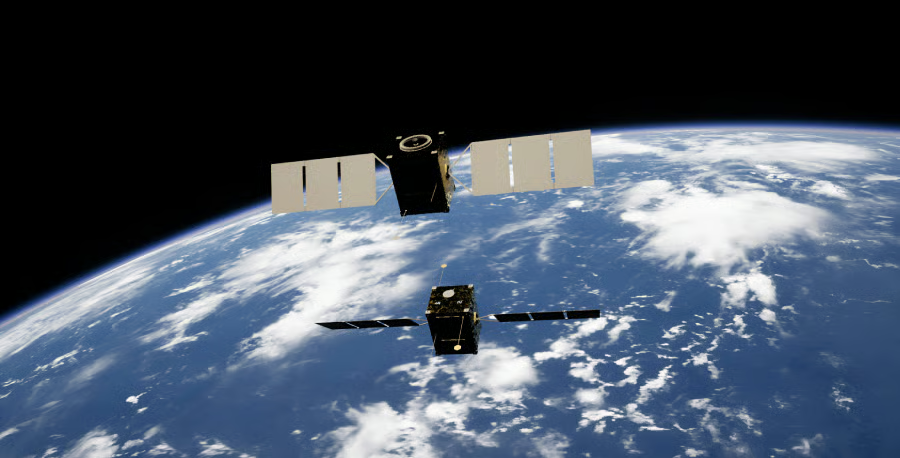
Shanghai Xingshu Tiansuan Space Technology and Fudan University unveiled the initial constellation for the Xingshu Plan on Saturday, marking an early step toward what the company says will become China’s first commercial space-based computing network.
Instead of sending massive amounts of raw satellite data back to Earth for processing, the system is designed to analyze data directly in orbit before transmitting only the results. Supporters say that approach can cut communication delays while reducing the strain on bandwidth.
The announcement came during the 2026 World Artificial Intelligence Conference (WAIC) in Shanghai, where Chinese President Xi Jinping promoted Beijing’s vision for global AI governance.
The launch also underscored China’s broader effort to expand AI infrastructure beyond traditional, ground-based data centers.
A long-term plan
According to China Daily, the project will roll out in multiple stages.
During the verification phase, developers plan to deploy two computing satellites and 12 edge-computing satellites. Commercial expansion would increase the network to 50 computing satellites and 100 edge-computing satellites before growing into a constellation of roughly 1,000 satellites in its final operational stage.
The Tiansuan Constellation is being developed as an open satellite research platform in three phases, allowing researchers to conduct experiments using real satellites while advancing satellite computing and networking technologies.
Competition is heating up
China is not the only country exploring AI computing in space.
Elon Musk’s SpaceX has been pursuing similar space-based computing efforts following its merger with xAI earlier this year. The goal is to support AI development by moving more computing resources into orbit.
Several Chinese organizations are also investing in the technology. At WAIC, AI company SenseTime announced new partnerships involving space-based computing infrastructure, including plans to launch four computing satellites this year with Adaspace and eventually help build a satellite computing constellation capable of scaling to 1,000 satellites, Global Times reported.
Industry representatives at the conference argued that space-based computing could offer advantages such as broader global coverage and lower operating costs while supporting future AI workloads.
Looking beyond the launch
The first satellites are only a small piece of a much larger vision, but they highlight how AI infrastructure is becoming a new arena for global competition.
Until now, most discussions around AI capacity have focused on building larger data centers and securing more powerful chips. China’s latest project suggests the next phase could involve distributing computing resources between Earth and space, potentially changing how satellite imagery, remote sensing and AI-powered services are delivered.
That vision also comes with challenges. Deploying and maintaining hundreds or thousands of satellites will require significant investment, reliable launch capacity and long-term coordination.
Whether space-based computing proves more efficient than expanding terrestrial data centers remains to be seen, but the technology is quickly moving from concept toward real-world testing.
Also read: Orbital data centers may first prove useful for space-native workloads, but launch costs, cooling, radiation, and maintenance remain major barriers.
