


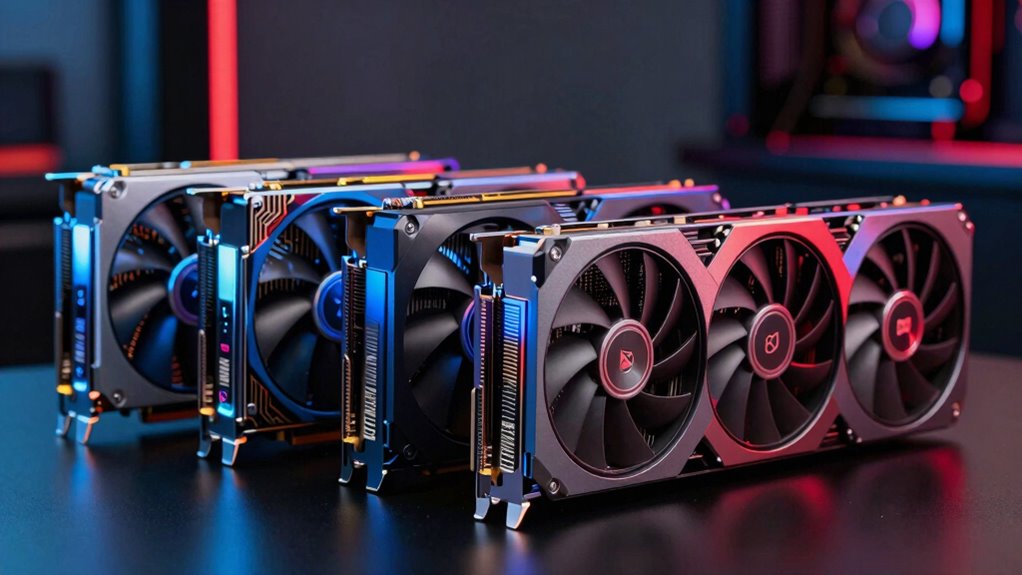
Finding a GPU capable of delivering smooth VR experiences without breaking the bank can be challenging. For 2026, I focus on options that balance affordability with enough power for most VR applications. The ASUS ROG Strix Radeon RX 570 stands out for its reliable performance and RGB flair, making it a great choice for gamers on a budget. Meanwhile, the AMD Radeon RX 580 offers more VRAM for better multitasking, but at a slight cost to power efficiency. For those who want a step up, the NVIDIA GeForce RTX 3050 provides advanced ray tracing features, though it’s limited to 6GB VRAM. This guide compares these options based on performance, features, and price, helping you pick the right GPU for your VR setup.
Which budget gpu for vr should you buy?
Memory — compared
ASUS ROG Strix Radeon RX 570 O4GB GDDR5
ReSpec.io AMD Radeon RX 640 Gr4GB
MOUGOL AMD Radeon RX 580 Gamin8GB GDDR5
XFX Radeon RX 470 4GB DDR5 Gra4GB DDR5
Complete the kit
Key Takeaways
- The ASUS ROG Strix RX 570 offers reliable VR performance at a lower price but is a refurbished model with limited warranty.
- The RX 580 provides more VRAM, ideal for multitasking and future-proofing, but consumes more power and is less efficient.
- The NVIDIA RTX 3050 combines ray tracing and AI enhancements, making it suitable for slightly more demanding VR experiences.
- Compact designs like the RX 640 are suitable for small builds but may lack the power needed for high-end VR.
- Refurbished options can save money but may come with wear or limited warranties, so consider your comfort with used components.
More Details on Our Top Picks
-
ASUS ROG Strix Radeon RX 570 O4G Gaming OC Edition Graphics Card
This card stands out for delivering solid VR performance at an affordable price, thanks to its OC mode boosting clock of 1310 MHz. The DirectCU II cooling system keeps temperatures manageable, and its RGB lighting adds aesthetic appeal. Compared with the RX 640, it offers more raw power and better cooling, but being a refurbished product might limit its warranty and overall longevity. It’s ideal for gamers who want dependable performance with a touch of style and don’t mind a secondhand unit with potentially limited coverage.
Pros:- Reliable performance for VR and gaming
- Enhanced cooling with DirectCU II technology
- RGB lighting with ASUS Aura Sync
Cons:- Refurbished product may have limited warranty
- No factory overclock beyond OC mode
- Generic packaging may affect presentation
Best for: Budget gamers seeking reliable VR performance and aesthetic flair
Not ideal for: Users who prefer brand-new hardware with full warranty or want a more compact, low-profile card
- Boost Clock:1310 MHz
- Engine Clock:1300 MHz
- Memory:4GB GDDR5
- Cooling Technology:DirectCU II with wing-blade fans
- VR Ready:Yes
- Connectivity:DisplayPort, HDMI, DVI
Our verdict
“A dependable choice for budget-conscious gamers who want style and reliability in VR.”
-
ReSpec.io AMD Radeon RX 640 Graphics Card, 4GB, Low Profile, Dell GPU 6044M (Renewed)
This low-profile RX 640 is designed for small cases and basic VR needs. Its 4GB VRAM makes it suitable for entry-level VR, but it falls short on future-proofing for more demanding titles. Compared to the RX 580, it’s less powerful but offers a significant size advantage, fitting into tight spaces. The renewed condition cuts costs, though it might have some wear, and the modest performance limits its use to less intensive VR applications. It’s best for users with compact systems who prioritize size over raw power, and who are willing to accept modest performance for the price.
Pros:- Compact low-profile design fits small cases
- Cost-effective renewal option
- Suitable for basic VR and multimedia
Cons:- Limited 4GB VRAM may hinder high-end VR
- Renewed condition might have wear
- Performance not ideal for demanding titles
Best for: Small form factor systems and entry-level VR users
Not ideal for: Power users needing high VR fidelity or multitasking with heavy workloads
- Brand:ReSpec.io
- Model:AMD Radeon RX 640
- Memory:4GB
- Form Factor:Low Profile
- GPU Model:Dell GPU 6044M
- Condition:Renewed
Our verdict
“A space-saving, budget VR option for those with small systems and modest performance needs.”
-
ASUS Dual NVIDIA GeForce RTX 3050 6GB GDDR6 OC Edition Gaming Graphics Card
This GPU offers a notable step up in VR rendering with NVIDIA’s Ampere architecture, supporting ray tracing and AI-enhanced features. Its 6GB VRAM is enough for many current VR titles, though it might limit some ultra settings. The dual Axial-tech fans ensure effective cooling, but some users might find it noisy under load. Compared to AMD options, it’s better at handling more graphically demanding VR, but the higher price and limited VRAM could be a barrier for the tightest budgets. It’s suitable for gamers who want a future-ready card without paying premium prices.
Pros:- Supports ray tracing and AI features
- Efficient cooling with dual fans
- Compact design for small cases
Cons:- Limited to 6GB VRAM, which may be insufficient for some VR scenarios
- No RGB or aesthetic features
- Potential noise under heavy load
Best for: VR enthusiasts wanting ray tracing and AI features within a budget
Not ideal for: Users with very tight budgets or those who prioritize maximum VRAM for large, high-resolution VR environments
- Graphics Coprocessor:NVIDIA GeForce RTX 3050
- RAM:6 GB
- GPU Clock Speed:4000 MHz
- Video Output Interface:HDMI
- Graphics RAM Type:GDDR6
- Maximum Resolution:3840 x 2160
Our verdict
“A smart choice for VR users seeking advanced rendering features without high costs, but watch VRAM limits.”
-
MOUGOL AMD Radeon RX 580 Gaming Graphics Card, 8GB GDDR5, Dual Fan Cooling
The RX 580 with 8GB of VRAM is a popular choice for budget VR, offering ample memory for multitasking and higher quality textures. Its dual fan cooling keeps temperatures in check during extended play sessions. Compared to the RX 470, it provides better performance and higher VRAM capacity, making it more capable for demanding VR titles. However, it consumes more power and is less efficient than newer models like the RX 640 or the RTX 3050. It’s best suited for users who want a straightforward, reliable VR experience at 1080p and don’t mind a slightly higher power draw.
Pros:- High-capacity 8GB VRAM suitable for demanding VR titles
- Effective dual-fan cooling system
- Supports multiple displays
Cons:- Requires a 6-pin power connector
- Power consumption is higher compared to newer GPUs
- Limited to PCIe 3.0 interface
Best for: 1080p VR gaming and content creation on a budget
Not ideal for: High-resolution VR or users wanting the latest features with lower power consumption
- Memory:8GB GDDR5
- Bus Width:256-bit
- Stream Processors:2048
- Core Clock:1206 MHz
- Video Outputs:DP, HDMI, DVI
- Interface:PCIe 3.0 x16
Our verdict
“A solid, budget-friendly VR card with enough VRAM for most 1080p applications, yet less efficient than newer options.”
-
XFX Radeon RX 470 4GB DDR5 Graphics Card
The RX 470 offers a decent entry point for VR at a very accessible price, with 4GB VRAM suitable for many current VR titles at 1080p. Its Triple X cooling system with a red fan ensures thermal management, and its support for DirectX 12 keeps it compatible with modern games. Compared with the RX 580, it’s less powerful and has less VRAM, limiting its longevity for more demanding titles. Still, for casual VR use or secondary systems, it provides reliable performance at a very affordable price. It’s ideal for users who prioritize cost above all else and have modest VR expectations.
Pros:- Affordable price point
- Triple X cooling system supports extended play
- Supports multiple monitors
Cons:- Limited to 4GB VRAM, restricting high-end VR performance
- Refurbished condition may affect warranty and longevity
- Performance at higher resolutions may be limited
Best for: Casual VR users and secondary PC builds
Not ideal for: Power users or those planning to run demanding VR titles at high settings
- GPU:AMD Radeon RX 470
- Memory:4GB DDR5
- Core Clock:1226 MHz
- Cooling System:Triple X cooling with red fan
- DirectX Support:12
- Refurbished:Yes
Our verdict
“An economical choice for casual VR gaming and basic multimedia, with limitations on future-proofing.”
What makes a great budget gpu for vr
1
Performance and VR Readiness
Look for GPUs with at least 4GB of VRAM, ideally 6GB or more if you plan to use high-resolution VR headsets or multitask.
2
Size, Compatibility, and Power
Small form factor builds benefit from low-profile cards like the AMD RX 640, but these often sacrifice raw power.
3
Reliability and Warranty
Refurbished GPUs can be a smart way to save money, but they come with tradeoffs in warranty and potential wear.
How to choose your budget gpu for vr
1
How we picked
Our selection process focused on GPUs that strike a balance between cost and VR-ready performance.
2
Performance and VR Readiness
Look for GPUs with at least 4GB of VRAM, ideally 6GB or more if you plan to use high-resolution VR headsets or multitask
3
Size, Compatibility, and Power
Small form factor builds benefit from low-profile cards like the AMD RX 640, but these often sacrifice raw power.
4
Reliability and Warranty
Refurbished GPUs can be a smart way to save money, but they come with tradeoffs in warranty and potential wear.
Vetted budget gpu for vr ·
The best budget gpu for vr, compared
5compared
8GB GDDR5top memory
How We Picked
Our selection process focused on GPUs that strike a balance between cost and VR-ready performance. I prioritized models with at least 4GB of VRAM, good cooling solutions, and compatibility with VR headsets. I compared features like clock speeds, cooling technology, and connectivity options, alongside user reviews and reliability reports. The goal was to identify options that are accessible for budget-conscious users yet capable of providing a smooth VR experience, avoiding overpowered high-end cards that are too expensive or underpowered models that can’t handle VR demands.
Everyday → specialist
Everyday & valuePremium & specialist
Which budget gpu for vr fits you?
The everyday user
All-round, reliable
The enthusiast
Premium & high-performance
The gift-giver
Looks & craftsmanship
Factors to Consider When Choosing Budget Gpu For Vr
Choosing a budget GPU for VR in 2026 involves balancing performance, price, and system compatibility. The ideal card should provide enough VRAM to handle modern VR titles, decent cooling to prevent thermal throttling, and connectivity options compatible with your VR headset. It’s essential to consider whether you prefer brand-new hardware for warranty and reliability or are okay with refurbished models to save money. Also, evaluate the size of your PC case—smaller systems benefit from low-profile options. This guide breaks down key factors to help you make an informed decision based on your specific VR needs and budget constraints.
Performance and VR Readiness
Look for GPUs with at least 4GB of VRAM, ideally 6GB or more if you plan to use high-resolution VR headsets or multitask. Clock speeds, cooling solutions, and driver support determine how smoothly your VR experience will run. Cards like the RX 580 and RTX 3050 outperform lower VRAM options, offering better frame rates and future-proofing, but often at a higher cost. Balance your expectations with what your system can handle and what kinds of VR titles you aim to play.
Size, Compatibility, and Power
Small form factor builds benefit from low-profile cards like the AMD RX 640, but these often sacrifice raw power. Ensure your power supply can support your chosen GPU—many budget options require a 6-pin power connector. Compatibility with your motherboard and case size is critical to avoid fitting issues and ensure proper airflow. Consider these factors alongside your performance needs to choose a GPU that fits both physically and within your budget.
Reliability and Warranty
Refurbished GPUs can be a smart way to save money, but they come with tradeoffs in warranty and potential wear. Always check the seller’s return policy and warranty coverage, especially for secondhand units. Newer models tend to have better driver support and longer lifespans, but may cost more. Decide how much risk you’re willing to accept and whether the savings outweigh potential concerns about longevity.
Frequently Asked Questions
Can a budget GPU handle VR gaming?
Yes, many budget GPUs are capable of running VR titles, especially those with at least 4GB of VRAM and a decent clock speed. While they might not run the most demanding games at ultra settings or high resolutions, they can provide a smooth experience for many mainstream VR applications. Keep in mind that settings may need to be adjusted for optimal performance, and some high-end VR experiences might require more powerful hardware.
Is refurbished hardware a good choice for VR?
Refurbished GPUs can offer significant savings but come with some risks, such as limited warranties or potential wear from previous use. If you’re comfortable with buying from reputable sources that test and refurbish their units, it can be a worthwhile way to get a capable VR GPU at a lower price. Just be sure to check the warranty details and return policies before purchasing.
How important is VRAM for VR headsets?
VRAM is critical for handling the high-resolution textures and data streams in VR applications. For most 1080p and 1440p VR headsets, 4-6GB of VRAM is sufficient, but more demanding titles or higher resolutions benefit from 8GB or more. Insufficient VRAM can cause stuttering or lower quality visuals, so consider your VR headset’s specifications and the games you want to play.
Should I prioritize new or used GPUs for VR?
Choosing between new or used depends on your budget and risk tolerance. New GPUs come with full warranties, better driver support, and longer expected lifespans, making them a safer choice. Used or refurbished cards can save money but might have wear or limited warranty coverage. If you’re on a tight budget and buy from reputable sources, used GPUs can be a good option; otherwise, investing in new hardware might be more reliable for VR.
What performance differences matter most for VR?
The most important factors for VR performance are frame rates, latency, and stability. A GPU with higher clock speeds, better cooling, and more VRAM will generally provide smoother, more comfortable VR experiences. Pay attention to minimum frame rates and how well the GPU handles sustained loads, as VR demands consistent performance to prevent motion sickness and discomfort.
Conclusion
For gamers on a strict budget who prioritize reliability and decent performance, the ASUS ROG Strix RX 570 offers a compelling mix of features, especially if you don’t mind buying refurbished. Users with small cases should consider the compact AMD RX 640, while those seeking a middle ground with better future-proofing might prefer the RX 580, despite its higher power draw. For enthusiasts wanting a bit more visual fidelity with ray tracing and AI features, the NVIDIA RTX 3050 makes sense if you can accommodate its VRAM limit and slightly higher cost. Ultimately, your choice depends on your specific VR setup, case size, and how much risk you’re willing to accept with refurbished components.
