The bank hopes to develop rather than displace jobs as it upskills its workforce across South-east Asia
[SINGAPORE] Ivan Aw’s first three months in his new role at UOB Private Bank were, in his own words, a “bruising” experience.
After spending more than a decade in personal financial services at UOB, he felt like he was starting from scratch, having stepped into the world of private banking and swapping familiar playbooks for a role with new jargon, ultra-high-net-worth clients and bespoke products.
“Growth often starts with discomfort,” recalled Aw, now vice-president of segment insights and digital engagement at UOB Private Bank. “What matters is your willingness to learn and adapt.”
This challenge was not simply a leap of faith; it was one well-supported by structured learning and mentorship. As part of UOB’s Better U Pivot Programme, Aw was able to undergo an on-the-job training plan with weekly learning objectives, while easing into the role with micro-projects.
The 12-month structured programme was designed to help employees of the bank reskill and transition into other roles within the organisation.
What Aw found particularly helpful were the weekly coaching sessions that the programme afforded him.
A NEWSLETTER FOR YOU

Friday, 8.30 am
Asean Business
Business insights centering on South-east Asia’s fast-growing economies.
“These sessions provided a safe space for open conversations about areas I could upskill in,” he said.
“Through those discussions, I was guided to courses that helped me build confidence and grow faster in my new role.”

Launched in October 2024, the Pivot Programme aims to reskill up to 500 UOB employees across the bank’s Singapore and Malaysia workforce over two years.
SEE ALSO

This initiative builds on the foundations of the bank’s wider Better U Programme, which was first launched in 2019 and has helped more than 26,000 employees enhance their skill sets across various banking and critical skill areas – including the use of artificial intelligence (AI).
The Better U Programme extends across UOB’s international presence in eight South-east Asian countries, and other parts of Asia including China, India, Japan and South Korea.
But as many in the banking sector have come to realise, learning to combine emerging digital tools such as AI with human skills has become crucial to defining the modern workforce.
Dean Tong, UOB’s head of group human resources, said: “In the financial services space, we’re seeing constant changes – new regulations, emerging technologies and macroeconomic volatility – all of which require organisations to respond quickly.”

For many employees, the choice is between learning to incorporate AI into their daily tasks, or risking replacement altogether.
UOB is keenly aware of these threats. “The challenge is to use AI to complement and augment human capabilities rather than displace jobs,” said Tong. “This requires upskilling and redesigning roles to ensure no employee gets left behind,” he added.
This vision was on full display at UOB’s Better U Festival on Oct 1, where the bank announced the launch of an organisation-wide AI upskilling programme. Under the new initiative, all employees will be equipped with foundational generative AI and productivity-boosting automation skills.
The new initiative will complement the Better U Pivot Programme. The bank said it will also develop talent to take on advanced digital roles, or serve as “innovation champions” who will drive adoption of generative AI into business processes throughout the organisation.
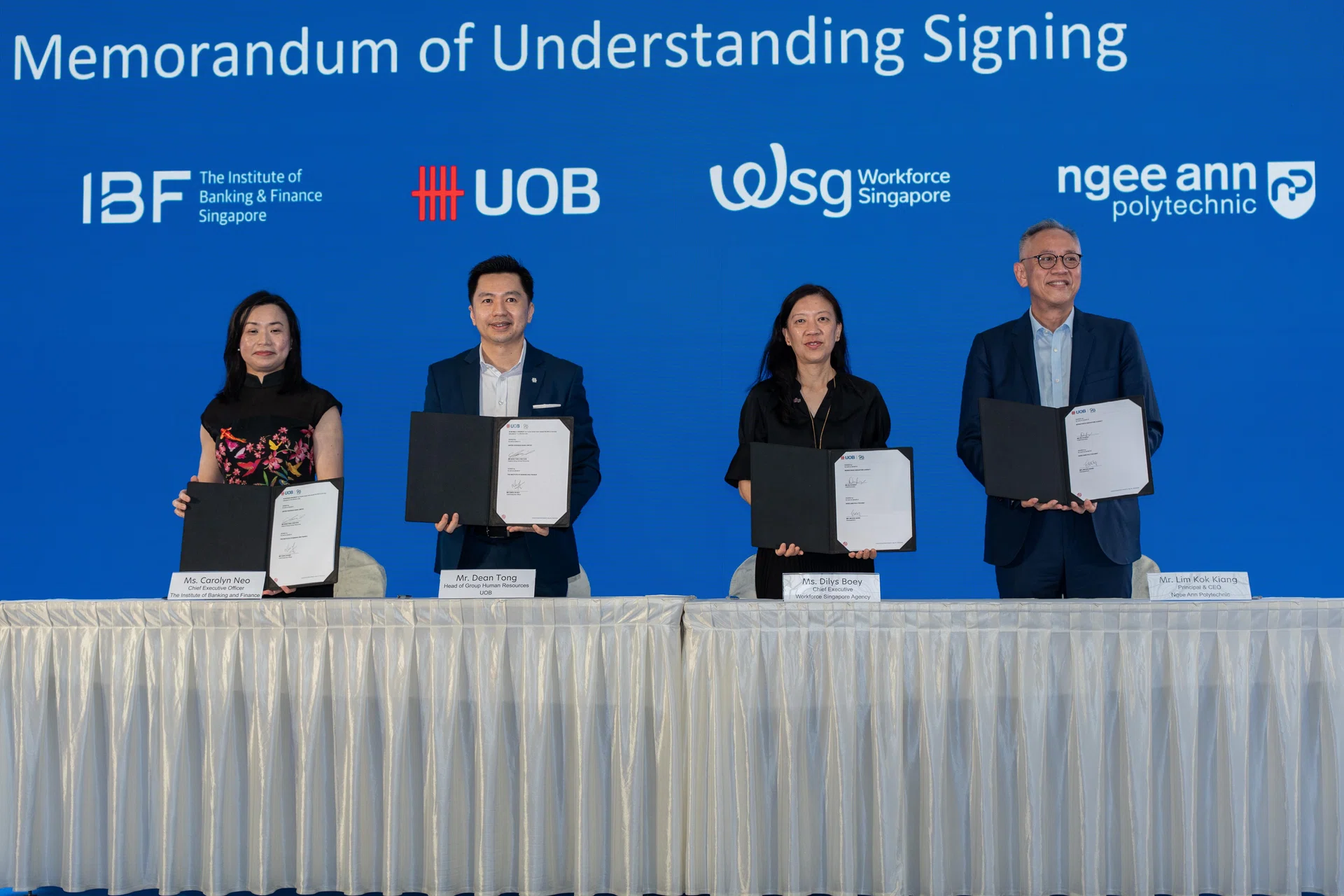
During the festival, UOB signed a memorandum of understanding with three learning institutes to enhance its efforts to upskill its employees.
A partnership with the Institute of Banking and Finance Singapore will focus on developing industry-accredited training programmes in areas such as generative AI and data fluency, the bank said.
UOB will also work with Workforce Singapore to redesign jobs most impacted by technological changes, in order to support the reskilling of affected employees.
Meanwhile, a collaboration with Ngee Ann Polytechnic will enhance these learning processes by introducing behavioural prompts and measuring their effectiveness.
Aw said that incorporating generative AI tools into his transition journey helped him gain confidence as he approached an unfamiliar work environment.
“These tools helped me bridge knowledge gaps quickly, whether it was summarising complex financial concepts, brainstorming campaign ideas or making sense of data,” he told The Business Times. “It didn’t replace the need to learn, but it definitely made the process faster and less overwhelming.”
Accelerating leadership growth
Beyond developing its employees across different banking skill sets, UOB has also prioritised developing effective leaders across its local and regional operations.
The bank has helped high performing individuals to develop their leadership potential and skills through its Leadership Acceleration Programme (LAP). Tong explained that the initiative was designed to provide strong performers with development opportunities through leadership coaching, job rotations and strategic project assignments.
Kacha Chotchaisatit is one such individual. Currently head of portfolio management and models for business banking at UOB Thailand, Kacha was selected to join the LAP in 2020 after going through a rigorous selection process.

Like Aw, Kacha’s growth as a leader required him to learn about new areas of the banking business. Despite being a domain expert in data-driven strategy, Kacha found his rotations into areas such as credit and risk management to be “humbling”.
But he believes they also transformed him into a better leader. “I no longer lead solely by providing answers,” he said. “Instead, I focus on setting the strategic direction and empowering my team to develop solutions themselves.”
Through initiatives such as the LAP and UOB’s Better Leader Programme, Tong noted that managers across UOB are developed to help their teams achieve growth.
Tong said these programmes “equip managers to lead authentically and effectively, promote psychological safety and build high-performing teams”.
He noted that UOB aspires for leaders such as Kacha to embody the “UOB way”: a people philosophy built on care, growth and trust, where employees are encouraged to take ownership of their work, as well as professional development.
But where generative AI is concerned, Tong acknowledged that risks remain as employees learn to incorporate new skills into their work.
“We are cognisant of the risk of an overreliance on generative AI, resulting in cognitive offloading. It is important for us to create a balance and ensure our people are also reskilled in critical thinking,” he said.
“We need to equip employees to use AI effectively and responsibly.”