


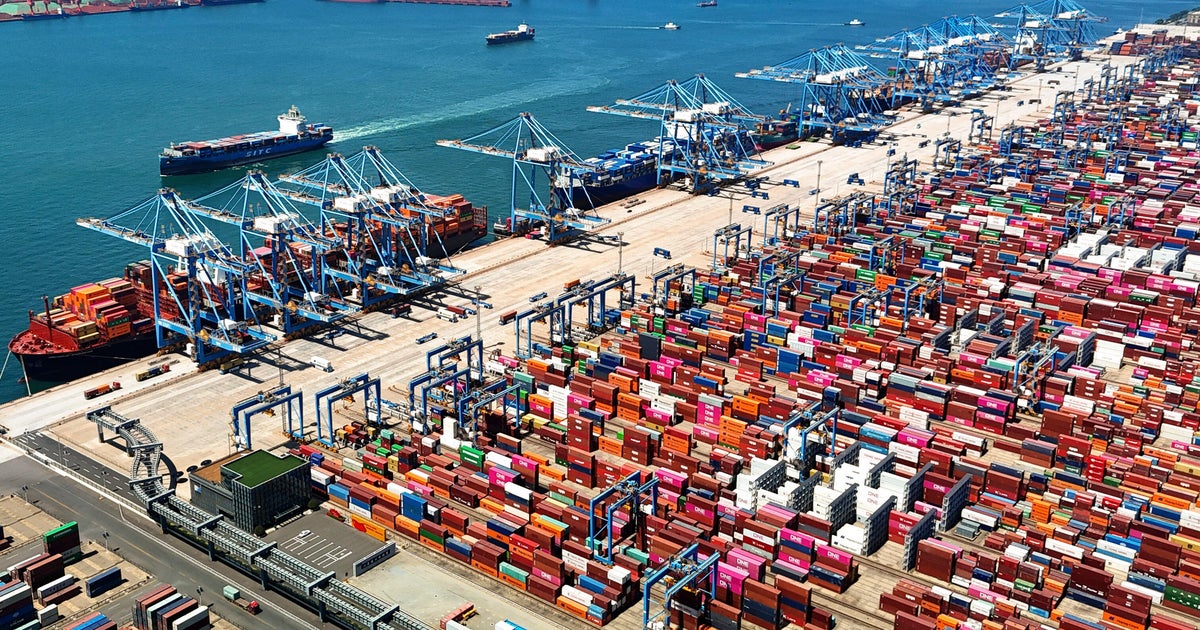
China has hit U.S.-owned vessels docking in the country with tit-for-tat port fees, in response to the American government’s planned port fees on Chinese ships, expanding a string of retaliatory measures before trade talks between U.S. President Donald Trump and Chinese leader Xi Jinping.
Vessels owned or operated by American companies or individuals, and ships built in the U.S. or flying the American flag, would be subjected to a 400 yuan ($56) per net ton fee per voyage if they dock in China, China’s Ministry of Transport said on Friday.
The fees would be applied on the same ship for a maximum of five voyages each year, and would rise every year until 2028, when it would hike to 1,120 yuan ($157) per net ton, the ministry said. They would take effect on Oct. 14, the same day when the United States is due to start imposing port fees on Chinese vessels.
China’s Ministry of Transport said on Friday in a statement that its special fees on American vessels are “countermeasures” in response to “wrongful” U.S. practices, referring to the planned U.S. port fees on Chinese vessels.
The ministry also slammed the United States’ port fees as “discriminatory” that would “severely damage the legitimate interests of China’s shipping industry” and “seriously undermine” international economic and trade order.
China has announced a string of trade measures and restrictions before an expected meeting between Trump and Xi on the sidelines of the Asia-Pacific Economic Cooperation forum in South Korea that begins at the end of October. On Thursday, Beijing unveiled new curbs on exports of rare earths and related technologies, as well as new restrictions on the export of some lithium battery and related production equipment.
The port fees announced by Beijing on Friday mirrors many aspects of the U.S. port fees on Chinese ships docking in American ports. Under Washington’s plans, Chinese-owned or -operated ships will be charged $50 per net ton for each voyage to the U.S., which would then rise by $30 per net ton each year until 2028. Each vessel would be charged no more than five times per year.
China’s new port fee is “not just a symbolic move,” said Kun Cao, deputy chief executive at consulting firm Reddal. “It explicitly targets any ship with meaningful U.S. links — ownership, operation, flag, or build — and scales steeply with ship size.”
The “real bite is on U.S.-owned and operated vessels,” he said, adding that North America accounts for roughly 5% of the world fleet by beneficial ownership, which is still a meaningful figure although not as huge as compared to Greek, Chinese and Japanese ship owners.
However, the United States has only about 0.1% of global commercial shipbuilding market share in recent years and built fewer than 10 commercial ships last year, Reddal added.
While shipping analysts have said that the U.S. port fees on Chinese vessels would likely have limited impact on trade and freight rates as some shipping companies have been redeploying their fleets to avoid the extra charge, shipping data provider Alphaliner warned last month in a report that the U.S. port fees could still cost up to $3.2 billion next year for the world’s top 10 carriers.
___
This story has been corrected to show that the Alphaliner report was from last month, not this month.
