


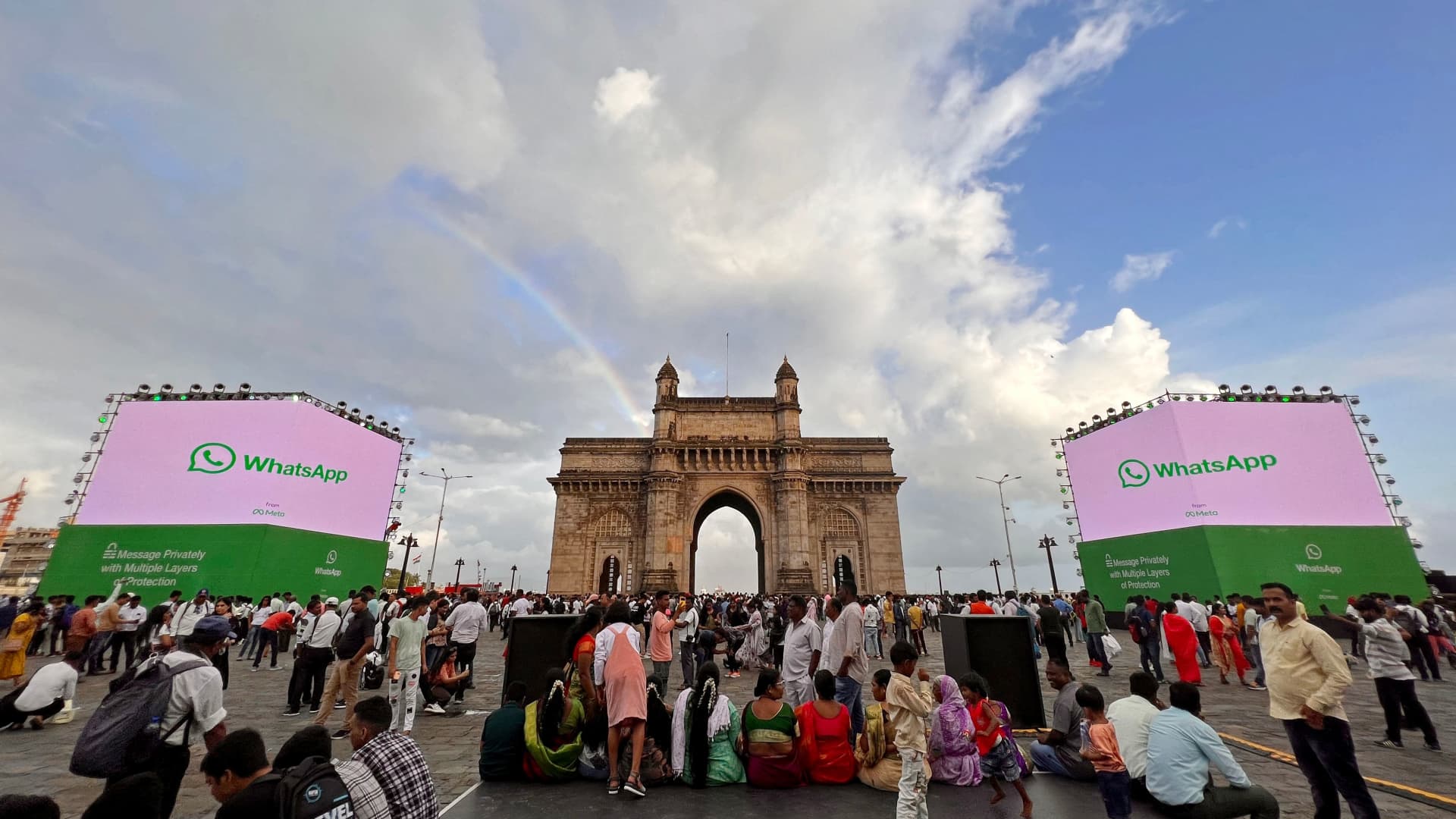
Tourists are seen at the promenade of the iconic Gateway of India next to digital displays of messaging app WhatsApp, in Mumbai on August 25, 2023. (Photo by INDRANIL MUKHERJEE / AFP) (Photo by INDRANIL MUKHERJEE/AFP via Getty Images)
Indranil Mukherjee | Afp | Getty Images
This report is from this week’s edition of CNBC’s “Inside India” newsletter which brings you timely, insightful news and market commentary on the emerging powerhouse. Subscribe here.
The big story
India’s quest for homegrown social media platforms and messaging apps has been as elusive as my friends on Arattai — the latest India-made “WhatsApp Killer,” depending on whom you ask.
Some see it as a bold challenger, others call it a copycat. The truth is somewhere in between.
India’s internet and smartphone userbase is second only to China, making New Delhi’s lack of homegrown social media and messaging apps quite striking when compared to Beijing’s bouquet of popular offerings.
More than a decade ago, China banned American social media and messaging apps, and it led to the rise of local players such as WeChat, Weibo and Douyin. South Korea and Vietnam did not even have to shun foreign products to built popular messaging apps KakaoTalk and Zalo, respectively.
But for a country that has built fintech powerhouses, e-commerce unicorns and numerous consumer tech apps, India’s inability to carve out a niche in the social media and messaging space has been quite puzzling.
Can Arattai — which means chit-chat in Tamil — progress beyond the initial chatter to emerge as a viable domestic alternative to WhatsApp? Or will it meet the fate of flash-in-the-pan apps such as microblogging site Koo that saw a similar euphoria around it but had to eventually shut shop?
In March 2020, serial entrepreneurs Aprameya Radhakrishna and Mayank Bidawatka, launched microblogging platform Koo in India, which was promoted as Twitter for non-English users. Driven by a nationalistic appeal celebrities and top influencers joined the app and within the first 18 month of its operation, Koo clocked 10 million downloads.
Government ministers too flocked to the local microblogging site, as the Indian state locked horns with X over content moderation disputes. In 2021, Koo raised $30 million in a funding round led by Tiger Global Management, according to data from Tracxn, and the following year the app reportedly went viral in Brazil.
But growing a new social media platform in a market dominated by deep-pocketed players requires funds and patience. The startup funding winter of 2023 threw a spanner in the works for Koo, as investors pulled away from supporting unprofitable businesses.
“By the time Koo stabilized their product, the capital dried up,” says Anurag Ramdasan, partner at Bengaluru-based venture capital firm 3one4 Capital that had invested in Koo.
For the next stage of growth, Koo needed business-to-business partnership to expand distribution of the app. They also needed experienced hires for business development, but those were too expensive without the funding support, Ramdasan added.
Funding could be one key difference between Arattai and those that came before it.
On stronger ground
Arattai is backed by Zoho Corporation, an Indian multinational company that makes business software and web-based tools. According to Tracxn financial database, Zoho clocked revenue of about $1 billion for the year ending March 2024 and a profit of more than $300 million.
In February this year, a report by Burgundy Private and Hurun India said Zoho was valued at around $11 billion, placing it among the most valued unlisted companies in the country.
“Koo was a limited attempt with limited venture capital money and limited amount of time,” says Anand Lunia, founding partner of venture capital firm India Quotient. He describes Zoho’s founder Sridhar Vembu as a “perpetual entrepreneur” with “no VC pressure.”
“I don’t think he is trying to win this in next three years or five years,” Lunia said.
While access to patient capital does set Arattai apart from the other Indian attempts at breaking the dominance of American social media and messaging apps in India, the road to success has more challenges.
Unlike China, local contenders need to woo away users from existing, popular platforms to make space for themselves. And to get users to switch, to create the network effect, the likes of Arattai need product differentiation.
“For any platform to be successful, they either need to do something significantly better than the previous competitor, offer something different, or have policy buoyancy [support],” says Joyojeet Pal, Professor of Information at the University of Michigan.
Looking past the hype
In the social media space, the products that have made waves in the last several years have brought something new to the table. Instagram focused on images, Snapchat brought filters, TikTok brought short videos, Clubhouse — which was briefly popular — brought a voice-only format.
Korea’s KakaoTalk was quick to capitalize on the lack of native-language options in the country back in 2010 by offering Hangul (Korean script), Pal said.
Making a messaging app popular “is extremely difficult without offering a new value proposition and as such, outside of group sizes, direct commerce, or integration of AI into the messaging process, there isn’t a lot more that messaging platforms can do,” said Pal.
Bottomline: Arattai needs a hook which can reel in users.
For now, it is banking on social media influencers, ministers and celebrities to endorse the platform, much like Koo. Arattai, which was launched in 2021, was largely unknown until the country’s education minister, Dharmendra Pradhan, mentioned it in a post on X on Sept. 24, urging Indians to switch to the homegrown apps.
That post catapulted the app into limelight leading to a surge in downloads. “We have faced a 100x increase in Arattai traffic in 3 days (new sign-ups went vertical from 3K/day to 350K/day),” Vembu said in a post on Sept. 29.
Arattai total downloads from Google Play Store stand at more than 10 million, still miniscule compared to WhatsApp’s 500 million users in India. Building an app with network effect takes time, and according to Lunia sometimes it needs more — government policy that jolts the system.
For instance the ban on TikTok in 2020 reportedly made Instagram the most popular short-video content app in India, while demonetization provided fertile ground for fintech apps to take off.
Demonetization was a policy move in November of 2016 by the government that sucked away about 86% of the currency in circulation in India, forcing the adoption of fintech apps and leading to the rise of companies such as Paytm and PhonePe.
Such policy moves are rare, and while key figures in the government including Prime Minister Narendra Modi have called for self-sufficiency in all spheres, urging adoption of homegrown products, banning U.S. apps to achieve that end is not in the cards.
So, Arattai will mostly have to rely on innovation that differentiates it from the competition, something Vembu has highlighted the company is pursuing aggressively. Will it work? I’ll update when my Arattai app starts buzzing with activity.
Top TV picks on CNBC

Taimur Baig, chief economist and managing director at DBS Group Research, said unlike the U.S., India is not turning inwards. New Delhi is engaging with and bringing foreign investors.

Mitul Kotecha, head of FX & EM macro strategy Asia at Barclays, said Indian central bank’s latest measures to internationalize the country’s currency are promising, comparing it to China’s efforts to push the yuan.
Need to know
Anthropic to open first India office as rival OpenAI boosts presence in the country. The company plans to open its first office in India, entering a market where artificial intelligence usage is growing and its rival OpenAI is already making headway.
U.S. tech giants hit pause on India data center deals under weight of trade uncertainty. The companies are delaying their decisions to lease large data centers in India, jittery from the recent souring of trade ties between New Delhi and Washington.
Tata Capital IPO, the largest so far this year, has been fully subscribed. The $1.75 billion IPO attracted particularly strong interest from qualified institutional buyers. Shares of the company will be listed on the exchanges on Monday, Oct. 13.
Quote of the week
India will not necessarily turn inward because the U.S. is turning inward … There will be a very different set of rules in dealing with the U.S., but elsewhere remaining open for business, letting the capital market become more dynamic is absolutely imperative.
— Taimur Baig, chief economist and managing director, DBS Group Research
In the markets
The Nifty 50 was up 0.36%, while the BSE Sensex had gained 0.33% on Thursday as of 12:45 p.m. local time. Year-to-date gains for the broader index stand at 6.4%, while the Sensex has advanced by just over 5%.
The benchmark 10-year Indian government bond yield was trading 2 basis point higher at 6.526%.

Coming up
Oct. 10: Canara HSBC Life Insurance Company launches IPO
Oct. 13: Shares of Tata Capital list on exchanges; India consumer price index data for September
Each weekday, CNBC’s “Inside India” news show gives you news and market commentary on the emerging powerhouse businesses, and the people behind its rise. Livestream the show on YouTube and catch highlights here.
SHOWTIMES:
U.S.: Sunday-Thursday, 23:00-0000 ET
Asia: Monday-Friday, 11:00-12:00 SIN/HK, 08:30-09:30 India
Europe: Monday-Friday, 0500-06:00 CET
