


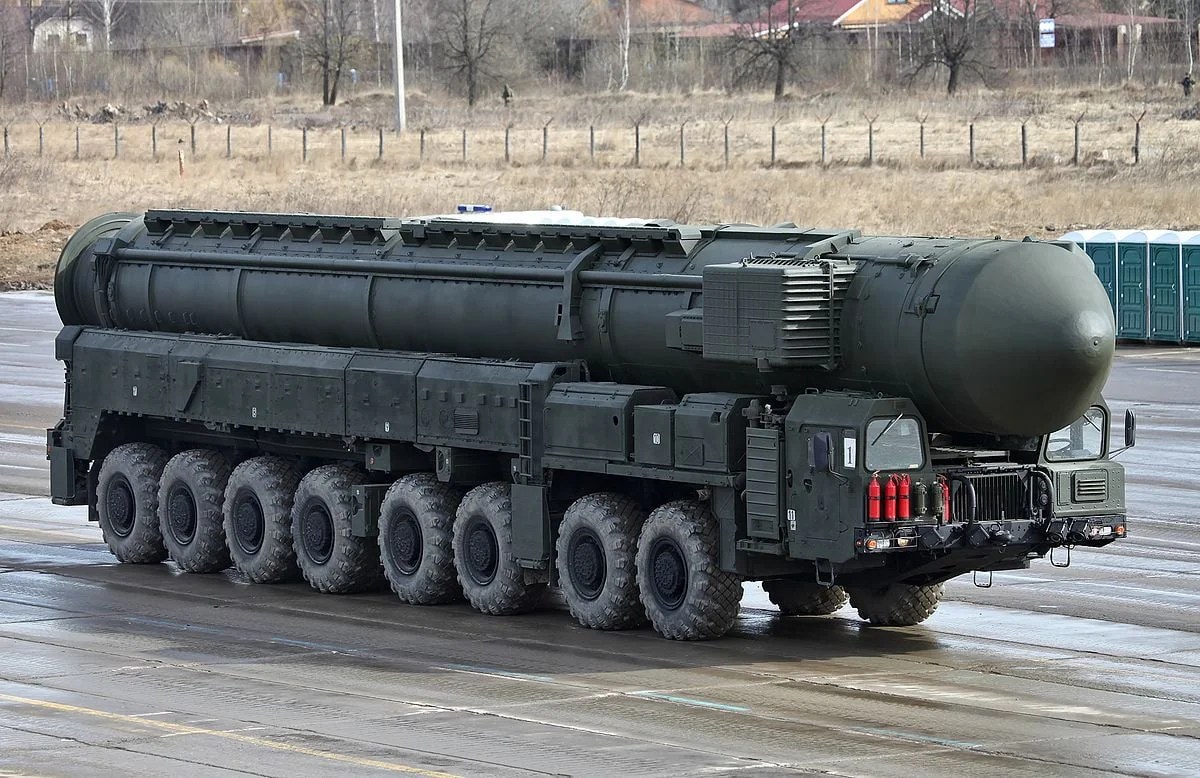

Is the Russian military’s worst nightmare its own vulnerability? The RS-28 Sarmat, or “Satan II” as the Russians are known to call it in NATO circles, has been promoted by Moscow as a weapon without equal — a missile capable of annihilating swaths of territory, outsmarting missile defense systems, and resetting the nuclear balance. But behind the hyperbole is a story of engineering overconfidence, strategic calculation, and increasingly, technological vulnerability.

Since its public debut in 2018, the Sarmat has led Russia’s nuclear modernization program, replacing the Cold War-era R-36M2 “Satan.” It is designed to deliver massive payloads, launch hypersonic glide vehicles, and reach almost any point on the planet. But ongoing delays, catastrophic test failures, and questions about its true strategic value have made it more difficult for the Kremlin to sell its narrative. This list breaks down the most compelling elements of the Sarmat story — from its brutal force of destruction to the geopolitical ripples it creates.

The RS-28 Sarmat is a liquid-fueled, three-stage intercontinental ballistic missile 35 meters in length and more than 200 metric tons in weight. It can haul up to 10 metric tons of cargo — enough for 10 large nuclear warheads, 16 small ones, or a mix of warheads and countermeasures. Its range is estimated at between 10,000 and 18,000 kilometers, said the Center for Strategic and International Studies, meaning it could conceivably hit any location on earth.

This throw-weight positions it as a replacement for the Soviet R-36M2 but with more flexibility. The ability of the missile to carry Multiple Independently Targetable Reentry Vehicles (MIRVs) is such that one launch would obliterate multiple cities. Military Today states that in one configuration, each MIRV could have a 0.75 megaton yield — more than ten times the Hiroshima bomb.

Russian officials claim the Sarmat can make non-conventional flight paths, e.g., flying along the South Pole, to bypass northward-aimed missile defense systems. It is also reported to be capable of carrying the Avangard hypersonic glide vehicle, which can make evasive maneuvers at up to Mach 20 speed, for much simpler interception.

While such capabilities are designed to respond to prospective U.S. missile defenses, analysts comment that America’s current ground-based interceptors, numbering merely thirty, are designed for limited-scale threats by states like North Korea, not a massive Russian attack. This raises the question of whether the Sarmat’s advanced evasion capabilities are strategically needed or purely psychological.

A Sarmat test on September 24, 2024, at the Plesetsk Cosmodrome was a failure that cratered and destroyed the launch silo, creating a 200-foot-wide crater. Satellite images showed extensive forest fires in the region. Early diagnosis is a failure of the first-stage booster, possibly linked to modifications to the design to make the boost phase of the missile shorter.

Shorter boost stages reduce the amount of time that missile defenses have to detect and track a launch, but adding them to a heavy liquid-fueled ICBM is dangerous. Possibilities are engine combustion instability from stepped engine designs or stress on the lighter orthogrid missile casing — both of which would be in line with the catastrophic outcome.

The Sarmat’s booster casing employs an orthogrid structure — a strength-saving, high-strength grid pattern usually found within the interior of missile casings. Unlike usual, footage from state media in Russia reveals the pattern on the interior as well as the exterior, indicating designers were working on significant structural issues.

These missiles can resist heavy weights, but they complicate production and inspection. Makeyev Rocket Design Bureau’s leading designer stated that the exterior would be wrapped with a protective cover to guard against space-based American missile defenses, a remark that is indicative of Russian planners’ obsession with nullifying future American capabilities.

The Sarmat will be the primary carrier system for the Avangard hypersonic glide vehicle, which is launched at approximately 100 kilometers altitude and can spin in arbitrary directions at mind-boggling speeds. In the meantime, until Sarmat becomes operational, Avangard remains based on refurbished SS-19 Stiletto missiles.

Avangard’s development itself faced issues of replacing Ukrainian-made control systems and heat shielding for up to 2,000°C surfaces. Its integration with Sarmat would provide massive throw-weight with warheads that are maneuverable — a combination which would be a challenge for any missile defense system. Russian lawmakers have been making sensational claims regarding the Sarmat’s devastating capability, with the claim from Duma lawmaker Alexei Zhuravlev that the U.S. East Coast could be destroyed by two Sarmats. While exaggerated, these remarks emphasize the contribution of the missile to nuclear signaling.

For NATO, the potential ability of the missile to outrun defenses makes the need for combined air and missile defense capabilities that much more urgent. It also insinuates itself into American nuclear modernization discussions, potentially accelerating the LGM-35A Sentinel replacement for the Minuteman III and influencing whether or not to maintain silo-based ICBMs.

The Sarmat program was plagued with delays right from the beginning in the 2000s. Tests of ejection scheduled in 2015 dropped back to 2017–2018, and the initial full flight test was only in 2022. At least one more flight test also failed before the 2024 tragedy, and two were aborted.

In spite of these problems, Russia is said to have accepted the Sarmat into service — an unusual action for a system with a checkered test history. This says more about the missile’s symbolic and strategic value than about its performance, but continuing reliability concerns may affect Russian crisis behavior, possibly leading to premature dispersal of mobile systems or other steps toward escalation during crises.

RS-28 Sarmat is the pinnacle of Russian missile engineering aspiration as well as the overextension trap. With its massive payload, global reach, and hypersonic carrier capability, it is a big gun for Moscow’s arsenal — on paper, at least. But repeated test failure and dubious necessity for some of its functionality render the “Satan II” at least as much a tool of psychological warfare as a mass destruction weapon. To planners and designers alike, its story is a reminder that in the era of nuclear weapons, perception can prove stronger than capability — and that even the most frightful arms are limited by the confines of their own design.
