



Countries should act on regional interests instead of playing follow-the-leader, says Singapore’s former foreign minister at SPH Media’s Southeast Asia Lecture Series
[BANGKOK] US President Donald Trump’s trade policies and tariffs may shift like the weather, but the climate of multipolarity is here to stay, said former foreign minister George Yeo, adding that the bigger question is whether the US can heal and rejuvenate.
“Trump’s nature will not change. We have three more years; after that, a new US president. May be easier, I don’t know… but the climate, which is multipolarity, is almost inevitable,” said the statesman on Thursday (Sep 25) at the South East Asia Lecture Series (SEA Lecture).
“The big question mark is the US itself. To what extent can it heal, revive and rejuvenate?” he asked at the event jointly presented by The Business Times and SPH Media’s flagship Chinese publication, Lianhe Zaobao.
Yeo headlined this third edition of the event, first delivering a keynote speech, and then speaking at a fireside chat on Trump’s economic impact on South-east Asia.
Moderated by the Chinese-language daily’s foreign editor Ng Hui Min, the session was followed by a question-and-answer session and a book signing.
In response to a question posed by the Thai Board of Trade vice-chairman Kasemsit Pathomsak on medium-term worst-case scenarios, Yeo said the greatest uncertainty remains the global financial situation, which, if brought to a head, would fracture politics.
A NEWSLETTER FOR YOU

Friday, 8.30 am
Asean Business
Business insights centering on South-east Asia’s fast-growing economies.
“The quarrel between the Treasury and the Fed suggests to me a certain fear that the US economy is not doing that well in substance,” he said.
It appears to be in good shape because the wealthy spur certain kinds of consumption and drive up asset prices, but, everywhere in the world, tensions in society are building due to excess liquidity and technological changes, he added.
And with another global financial crisis due – this time with much higher debt levels – the world may end up in a big financial hole, turning politics ugly globally, he said.
SEE ALSO

Held in Bangkok, the lecture hosted members of the business community, academics, policymakers and students from Siam University. The previous two editions were held in Singapore and Kuala Lumpur.
Asean, a beacon of peace
SPH Media’s chief executive Chan Yeng Kit said in his opening remarks: “Since the last SEA Lecture in Malaysia… the world seems a lot more unsettled and chaotic. The established security and economic order that South-east Asia relied upon for prosperity is under stress.”
Yet amid this uncertain global backdrop, the region continues to stand out as one of hope and promise, he said.
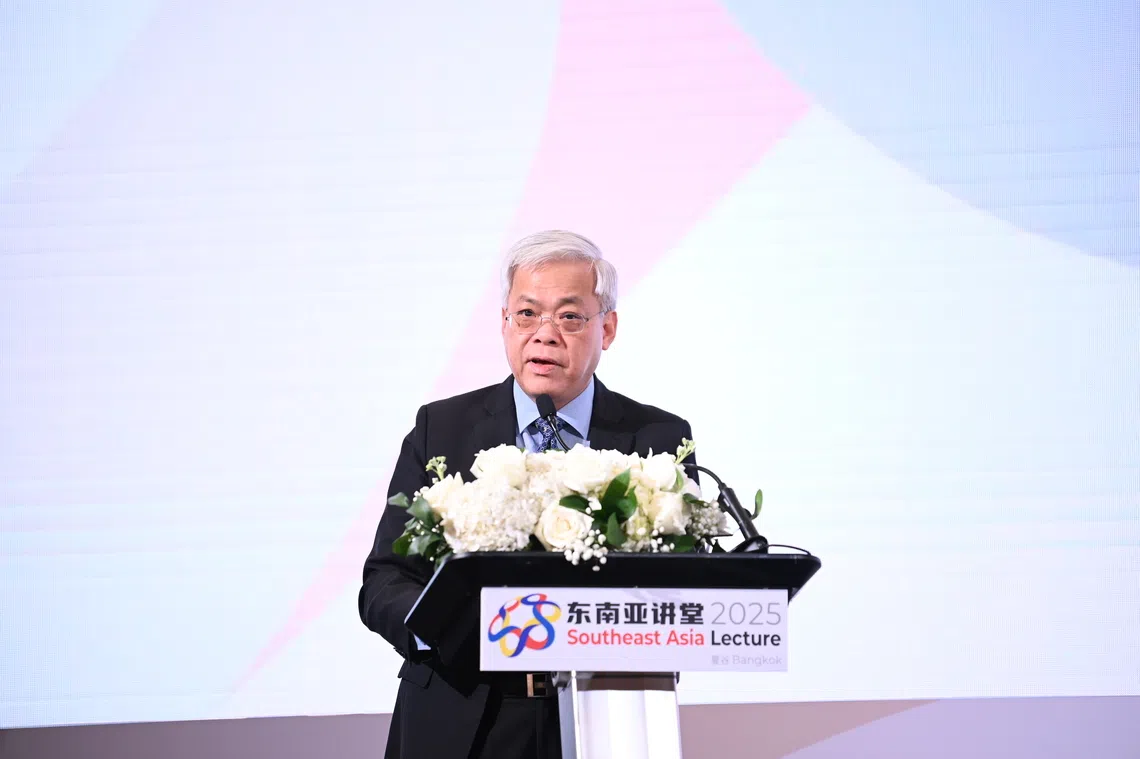
Picking up on the point, Yeo said in his keynote speech that as the world marches towards uncertainty, friendship and the instinct for cooperation – such as that between Singapore and Thailand – become all the more important.
“The links of friendship and trade go back a long time… almost woven into the fabric,” he added, jesting that Singapore’s famed chicken rice cannot be made without Thai rice.
In times of trouble, whether it be in the South China Sea, Myanmar or at the Thai-Cambodian border, the instincts of the rest of the region must be to act as peacemakers and not troublemakers, the former politician said.
“We may be angry at one another from time to time and even come to blows, but the rest of us should calm everybody down. This instinct for peace is very important.”
He added that as the faster-growing half of the world’s population, the region can make a big contribution to global peace by ensuring its own stability and growth.
“But if we lose our heads and start pouring kerosene onto small fires, we are just burning ourselves,” said Yeo.
Act in regional interests
Such regional peacekeeping and strength become especially important, with Trump fast-forwarding the future.
The fact that the US is abandoning the institutions which it helped to create after the Second World War, such as the United Nations and the World Health Organization, is a sign not of strength, said Yeo, but of weakness.
“The fact that the rhetoric has changed and the actions follow the rhetoric is really a clear indication to us of how that old regime is dissolving before our very eyes. It requires from us an adjustment.”
The world may be used to referencing the US for standards, leadership and new thinking, but such a shift does not translate into the abandonment of old beliefs, he said.
“It means that increasingly, on all these key issues, we have to think for ourselves and calculate the interest of our own regions because, in the end, we will depend on regional stability to be able to do well.”
Leverage China’s rise – economically
China was brought up several times. Attendees broadly asked about Chinese investments in the region, whether companies are shifting away from the China-plus-one strategy and the superpower’s role in global leadership, as well as what it all means for South-east Asia.
Yeo said he believed that the overall policy is to welcome Chinese investors in select industries that can boost the local economy, while still keeping an eye out for investments that could pose strategic dangers to the nation.
Investments in sectors such as infrastructure can help the country grow if managed skilfully, he said, citing the example of a railroad, which can be nationalised and built more quickly and cost-effectively.
“South-east Asia can acquire first-world infrastructure within a short period of time by leveraging its relationship with China,” said Yeo. “But if they’re acquiring strategic assets, the key technologies, then maybe we should be more worried.”
He added that he does not buy into what he described as the Western belief that China’s Belt and Road Initiative is a debt trap, saying: “The Chinese are Chinese. They want to make money, whether it’s a state-owned enterprise or private company.”
On concerns that China would behave like a Western imperial power when it rises to strength, Yeo made the observation that the Chinese prefer not to use military force; instead, they want to leverage the country’s economic heft.
“They’ve, over centuries, developed sophisticated statecraft to make use of their market to influence the behaviour of all their neighbours,” he said. “If they’re happy with you, the gifts you give them will be small compared to the gifts they give you.”
He emphasised that the pattern of history in East Asia differs greatly from that of America or Europe. “To understand our future, we must not only see it from Western perspective; we must also see it from our perspective.”
