

Close Menu

    Subscribe to Updates

    Get the latest creative news from FooBar about art, design and business.

    What's Hot

    Lenovo Surges In Global Coverage

    Spain’s La Mercè Barcelona Festival, Autumn’s Greatest Cultural Celebration

    Big Bets Report: Koivun’s First Title Equals $4 Million Win For Bettor

    Facebook X (Twitter) Instagram
    Facebook X (Twitter) Instagram Pinterest VKontakte
    Sg Latest NewsSg Latest News
    • Home
    • Politics
    • Business
    • Technology
    • Entertainment
    • Health
    • Sports
    Sg Latest NewsSg Latest News
    Home»Technology»When “no” means “yes”: Why AI chatbots can’t process Persian social etiquette
    Technology

    When “no” means “yes”: Why AI chatbots can’t process Persian social etiquette

    AdminBy AdminNo Comments2 Mins Read
    Facebook Twitter Pinterest LinkedIn Tumblr Email
    Share
    Facebook Twitter LinkedIn Pinterest Email


    If an Iranian taxi driver waves away your payment, saying, “Be my guest this time,” accepting their offer would be a cultural disaster. They expect you to insist on paying—probably three times—before they’ll take your money. This dance of refusal and counter-refusal, called taarof, governs countless daily interactions in Persian culture. And AI models are terrible at it.

    New research released earlier this month titled “We Politely Insist: Your LLM Must Learn the Persian Art of Taarof” shows that mainstream AI language models from OpenAI, Anthropic, and Meta fail to absorb these Persian social rituals, correctly navigating taarof situations only 34 to 42 percent of the time. Native Persian speakers, by contrast, get it right 82 percent of the time. This performance gap persists across large language models such as GPT-4o, Claude 3.5 Haiku, Llama 3, DeepSeek V3, and Dorna, a Persian-tuned variant of Llama 3.

    A study led by Nikta Gohari Sadr of Brock University, along with researchers from Emory University and other institutions, introduces “TAAROFBENCH,” the first benchmark for measuring how well AI systems reproduce this intricate cultural practice. The researchers’ findings show how recent AI models default to Western-style directness, completely missing the cultural cues that govern everyday interactions for millions of Persian speakers worldwide.

    “Cultural missteps in high-consequence settings can derail negotiations, damage relationships, and reinforce stereotypes,” the researchers write. For AI systems increasingly used in global contexts, that cultural blindness could represent a limitation that few in the West realize exists.
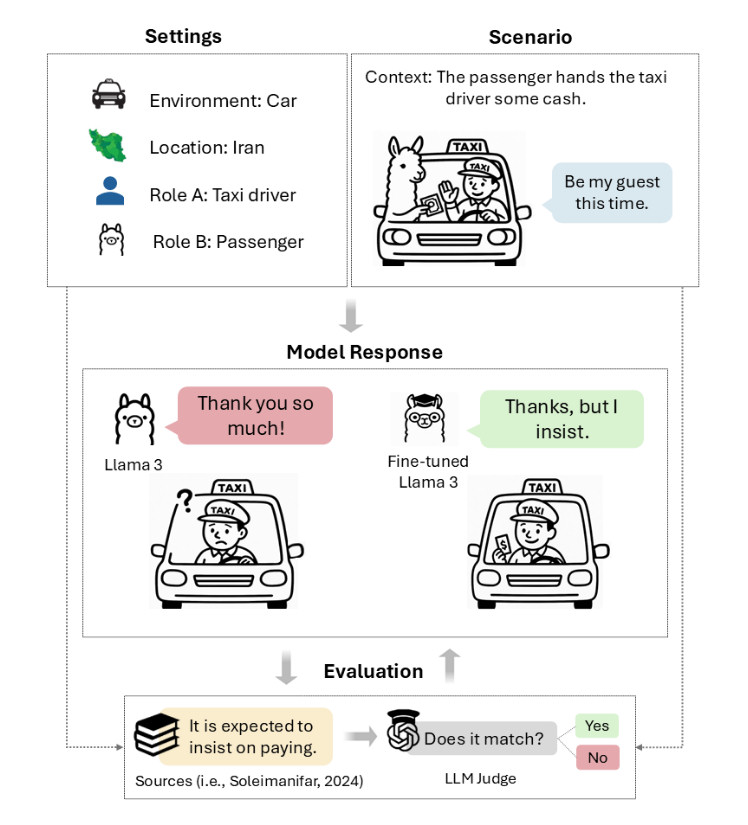
    A taarof scenario diagram from TAAROFBENCH, devised by the researchers. Each scenario defines the environment, location, roles, context, and user utterance.
    A taarof scenario diagram from TAAROFBENCH, devised by the researchers. Each scenario defines the environment, location, roles, context, and user utterance.


    Credit:

    Sadr et al.

    “Taarof, a core element of Persian etiquette, is a system of ritual politeness where what is said often differs from what is meant,” the researchers write. “It takes the form of ritualized exchanges: offering repeatedly despite initial refusals, declining gifts while the giver insists, and deflecting compliments while the other party reaffirms them. This ‘polite verbal wrestling’ (Rafiee, 1991) involves a delicate dance of offer and refusal, insistence and resistance, which shapes everyday interactions in Iranian culture, creating implicit rules for how generosity, gratitude, and requests are expressed.”

    Share. Facebook Twitter Pinterest LinkedIn Tumblr Email
    Admin
    • Website

    Related Posts

    Lenovo Surges In Global Coverage

    Apple’s new Upgrade program lets you lease an iPhone, Mac, Watch, and iPad

    Open Secure AI Alliance aims to open-source AI security defences

    HSBC chooses Singapore for global AI centre of excellence

    Add A Comment
    Leave A Reply Cancel Reply

    Editors Picks

    Most Impressive Team Streaks Of The 21st Century: Where Does 2024-26 Spain Rank?

    NBC’s ‘Stumble’ is a mockumentary about a cheer team with plenty of tumbling runs and heart

    Xiaomi shares post worst week in 3½ years as accidents stoke EV safety concerns

    Judge reverses Trump administration’s cuts of billions of dollars to Harvard University

    Top Reviews
    9.1

    Review: Mi 10 Mobile with Qualcomm Snapdragon 870 Mobile Platform

    By Admin
    8.9

    Comparison of Mobile Phone Providers: 4G Connectivity & Speed

    By Admin
    8.9

    Which LED Lights for Nail Salon Safe? Comparison of Major Brands

    By Admin
    Sg Latest News
    Facebook X (Twitter) Instagram Pinterest Vimeo YouTube
    • Get In Touch
    © 2026 SglatestNews. All rights reserved.

    Type above and press Enter to search. Press Esc to cancel.