






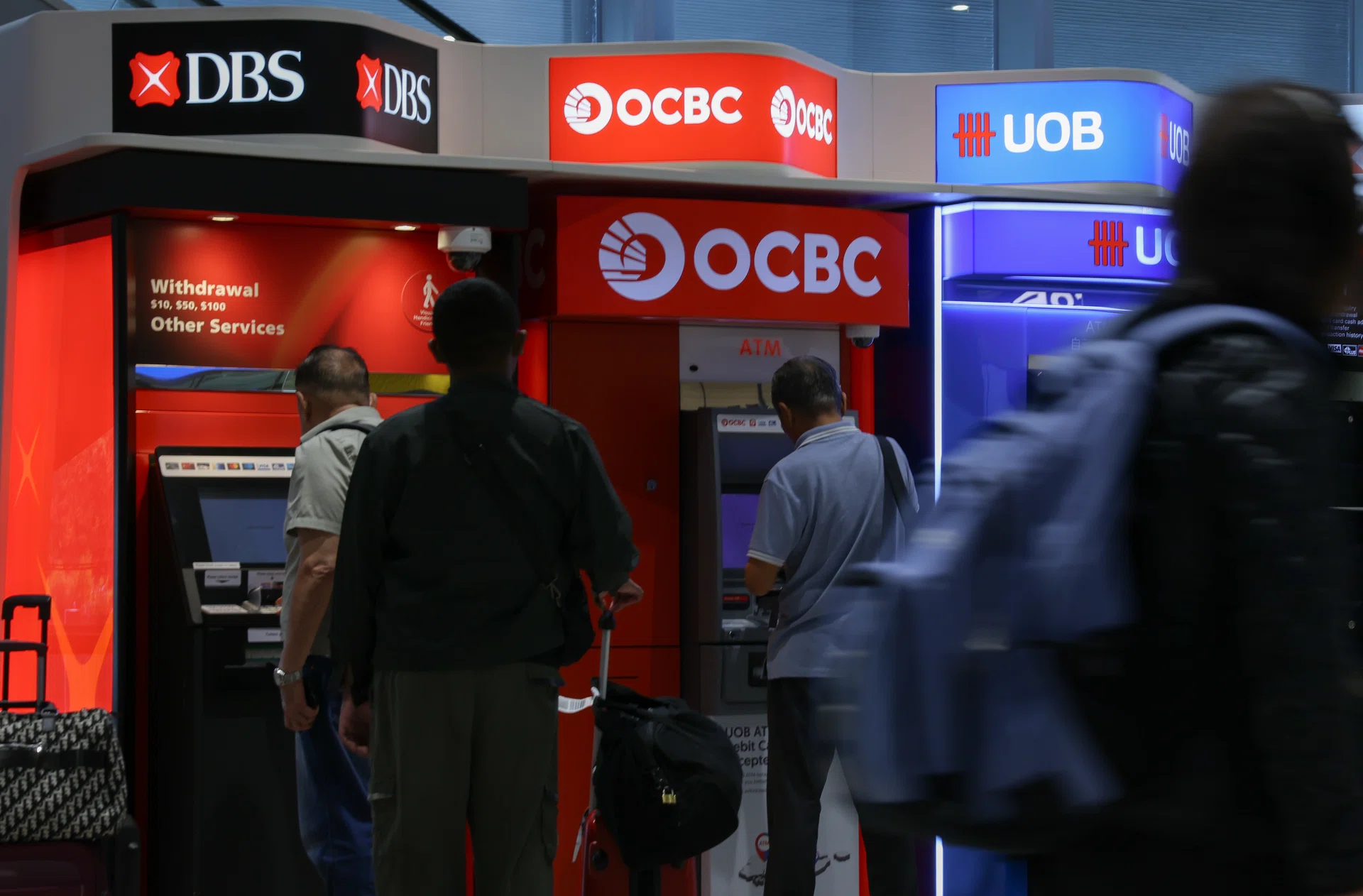
DBS and OCBC upgraded parts of their full-year outlook, while UOB turned more cautious on fees
[SINGAPORE] Singapore’s three banks continued to grow their earnings in the second quarter despite pressure from lower interest rates, with wealth management emerging once again as a key source of growth.
DBS’s net profit rose 9 per cent year on year to S$3.08 billion, while OCBC posted a 22 per cent increase to S$2.22 billion. UOB’s net profit climbed 10 per cent to S$1.48 billion, as higher fee and other non-interest income helped offset weaker net interest income.
But beneath the headline numbers, the three lenders struck somewhat different notes on the outlook for the rest of the year – and on emerging issues ranging from China’s new tax rules to the potential for artificial intelligence to contribute to the bottom line.
DBS was the first of the three banks to report its Q2 results on Thursday (Aug 6), followed by OCBC and UOB on Friday.
Here are five takeaways from their Q2 results:
1. Wealth remains the biggest earnings engine
As falling interest rates squeeze lending margins, wealth management continues to do much of the heavy lifting for Singapore’s banks.
At DBS, wealth management income grew 16 per cent in the first half to S$3.3 billion, while assets under management crossed S$500 billion. The business helped lift net fee income by 20 per cent to a record S$2.94 billion over the period.
That strength was a major reason the bank became more upbeat about its full-year non-interest income outlook, with CEO Tan Su Shan saying the team was “firing on all cylinders and building a strong foundation for future growth”.
OCBC similarly recorded strong growth from its wealth franchise, with wealth management income rising 27 per cent in the first half to a record S$3.29 billion.
UOB’s wealth management income rose 16 per cent year on year in the first half to S$717 million, while high-net-worth assets under management grew 7 per cent to S$204 billion.
Its momentum has been particularly strong outside Singapore, with wealth income from its four key Asean markets – Malaysia, Indonesia, Thailand and Vietnam – rising 30 per cent.
The bank is also looking to lean further into wealth after its strategic tie-up with Allianz Global Investors, which will allow it to focus more heavily on distribution and advisory while drawing on the global asset manager’s product capabilities.
2. Guidance shows a more uneven outlook for the second half
The banks’ guidance revisions point to different expectations for the remainder of 2026.
DBS raised its forecast for commercial-book non-interest income growth to the mid-teens, led by wealth management, and now expects total income for the year to exceed 2025 levels. It also expects group net interest income to narrow its gap with last year’s level.
OCBC made one of the more notable upgrades, raising its full-year loan growth forecast from mid single-digit growth to the high single-digit to low double-digit range.
That followed particularly strong lending growth in Q2, although group CEO Tan Teck Long cautioned against extrapolating the pace into the rest of the year. The lender also expects full-year income to grow year on year despite a slight decline in net interest income.
UOB, meanwhile, was more circumspect.
It maintained its low single-digit full-year loan growth forecast and net interest margin guidance of between 1.75 and 1.80 per cent, but cut its fee-income growth forecast to the low single digits from high single digits previously.
UOB continues to expect its 2026 earnings to be broadly flat against 2025.
3. China’s offshore tax changes have yet to trigger significant outflows
China’s increased scrutiny of offshore wealth has emerged as a new issue for banks with sizeable Greater China wealth businesses, but the lenders said they have yet to see a meaningful impact.
The changes include rules surrounding offshore trusts and the taxation of overseas investment income, raising questions over whether wealthy Chinese clients could shift assets or restructure their holdings.
OCBC said Bank of Singapore – its private banking arm – has not seen any significant asset outflows since news of the changes emerged. Its offshore trust business is also relatively small, while clients have largely been seeking clarification on how the rules apply.
DBS similarly indicated that it was too early to draw conclusions. Tan noted that the bank will comply with the rules while continuing to build out its domestic wealth capabilities in China – meaning it can still serve clients if more assets remain onshore.
UOB also described the development as recent, and said it was still assessing the implications.
“We don’t see any material impact at the first instance, but it’s still something we’re watching carefully,” said CFO Leong Yung Chee.
4. AI is everywhere – but banks differ on how close it is to generating revenue
All three lenders are deploying AI extensively, but their comments pointed to how difficult it remains to isolate its financial contribution.
DBS has perhaps gone furthest in framing AI as a potential revenue generator. It is using the technology for functions such as idea generation and to prompt customers with relevant opportunities, which can in turn generate transaction and fee flows.
OCBC’s Tan took a different approach. “We don’t really have an AI strategy per se,” he said, explaining that AI sits within the bank’s broader “ADD” strategy encompassing digitisation, data analytics and AI.
The focus is on applying the technology where it is fit for purpose rather than pursuing AI for its own sake, he added.
UOB, meanwhile, said more than 30,000 employees have access to Microsoft Copilot, while over 300 AI use cases have been rolled out across the bank. Staff are generating more than 400,000 Copilot prompts a month, noted Leong.
But it is not yet putting a dollar figure on the benefits. UOB has engaged an external auditor to help establish a framework for measuring AI’s impact, which it expects to complete by the end of the year, with a view to reporting the numbers regularly thereafter.
5. Investors rewarded DBS and OCBC, but UOB fell after results
The market response also diverged after the banks reported their results.
DBS shares ended the week at a fresh record high of S$76.33, having gained 3.9 per cent since its results were released on Thursday. The counter is up 35.4 per cent year to date.
OCBC shares closed 3.3 per cent higher at S$30.30 on Friday, after touching a fresh record high of S$30.50 intraday. The counter has gained 53.3 per cent since the start of the year.
UOB shares, however, fell 0.6 per cent to S$43.30 following its results on Friday. The counter is still up 23.5 per cent year to date.


